Loving God is not enough,
Because without repentance,
It’s not God you love …
But your own concept of Him.

Loving God is not enough,
Because without repentance,
It’s not God you love …
But your own concept of Him.
A Christian can’t truly love the LGBTQ community …
Without opposing the deceptions that trap them in sin and bondage.
I’ve seen more carnal rubbish under claims of being “in the Spirit” than I care to remember.
In contrast, I’ve found that those who live lives of quiet humility and faithful obedience …
More often are the real deal.
If you’re not a disciple …
You’re not a Christian.
Because there is no “Christ” in “Christian” …
Without God’s rule.
If we’re not about redemption, then what hope does anyone have?
This is my passion.
This is my cause.
But it ain’t neat and it ain’t tidy.
It’s raw and sometimes ugly.
Because if Jesus doesn’t work for the worst of us …
Then He works for none of us.
God’s presence without His sovereignty …
Is an impossibility.
Which is why I’m convinced that what we call “worship” and “His presence” at many “churches” these days …
Is so bogus.
It’s just emotional manipulation, masquerading as “worship” …
To generate feelings of intensity, and calling it “God” …
During a staged performance, claiming to be “church.”
————————————
“I appeal to you therefore, brothers, by the mercies of God, to present your bodies as a living sacrifice, holy and acceptable to God, which is your spiritual worship. Do not be conformed to this world, but be transformed by the renewal of your mind, that by testing you may discern what is the will of God, what is good and acceptable and perfect.” Rom. 12:1-2
There’s nothing entertaining …
About authentic worship.
Because authentic worship, as the New Testament actually defines it, means living lives of sacrificial service and reverent obedience.
Maybe this explains why real worship among many “Christians” and “churches” these days …
Is so rare.
Revivals come and revivals go …
But true repentance lasts forever.
“Worship” has been reduced from its Biblical meaning of living lives in obeisance (humble submission) and obedience to God …
To music that makes us feel good.
Although music can be a good thing …
Somehow, I think we lost our way.
God speaks …
Therefore, I am.
Everyone is entitled to their own opinion …
But not to a Christ of their own perception.
He created and defines us …
And not us Him.
Jesus never said we’re saved by asking Him into our heart …
But by surrendering to His Kingdom rule and doing His Father’s will.
That’s called repentance.
Those who proclaim anything less …
Are preaching a lie.
The me-centered, contrived intensity that many call “worship” these days …
Is an affront to God’s holiness.
In the New Testament, true worship is living lives of obeisance (humble submission) and obedience to Him, as He mandates …
Rather than projecting our own carnality onto Him to feed our own soulish needs.
Let’s return to the true God of Scripture with authentic worship …
As actually defined and commanded by Him.
Because when we relate to God on His terms rather than ours …
Amazing things of eternal significance will start happening in your own life and those around you.
Authentic citizens of God’s Kingdom …
Are the greatest force for reforming earthly kingdoms.
History proves this time and again …
And God is not yet done with history.
If, however, you’ve not the grace to heed His call outside your own comfort zones …
Then at least don’t diss those who do.
It’s ironic how some think that elevating Christ as the Living Word …
Means discounting His written Word of Scripture.
Is Christ divided?
He’s all or nothing …
Because there is no pick-and-choose Jesus.
A “relationship” with a purely subjective Jesus, apart from His plenary authority of Scripture as His written Word …
Leads to inauthentic faith.
Likewise, “truth” based on the plenary authority of Scripture without Jesus alive in us …
Also leads to an inauthentic faith.
Each extreme – born of an endless cycle of reaction to the other – chronicles two tragic trends of Church history.
Unfortunately, we still see these extremes played out today.
Authentic faith embraces the fulness of Christ:
Both His Person …
And what He has revealed in His written Word of Scripture.
Nonetheless, where my subjective perception of Him differs from His written self-disclosure, objective precepts and propositional truths of Scripture …
I must yield to Scripture.
There can be no maturity in Christ or functional communities of believers apart from these essentials.
Salvation isn’t about “asking Jesus into your heart”.
There’s nothing in the New Testament which says that.
Rather, it’s about repenting and submitting to His Kingdom …
On His terms, not ours.
When we stand before Him on that final day …
It will be the only Gospel that counts.
Someone asked if I believe in female clergy.
No way, no how!
But then again, I don’t believe in male clergy either. 😉
Seriously, there is no clergy/laity divide in the New Testament.
Instead, we are ALL commanded to submit one to another as we minister to each other …
No matter what differing function, diverse gift or level of grace we’ve been given.
The true Gospel calls us to repentance through the uncompromising conviction of the Holy Spirit …
Rather than appeal to our vanities through the compromising enticements of men.
God and “me” are not the church …
But God and “we” just might be.
There is no Christ …
In a “Jesus” on our terms.
Likewise, there is no ekklesia …
In a “church” on our terms.
Nor is there true “worship” …
When defined on our terms.
So in all our ways
Let’s humble ourselves
And submit to God …
As He defines Himself
And so much more
In His written word of Scripture.
Cynicism isn’t a retreat from evil …
But from good.
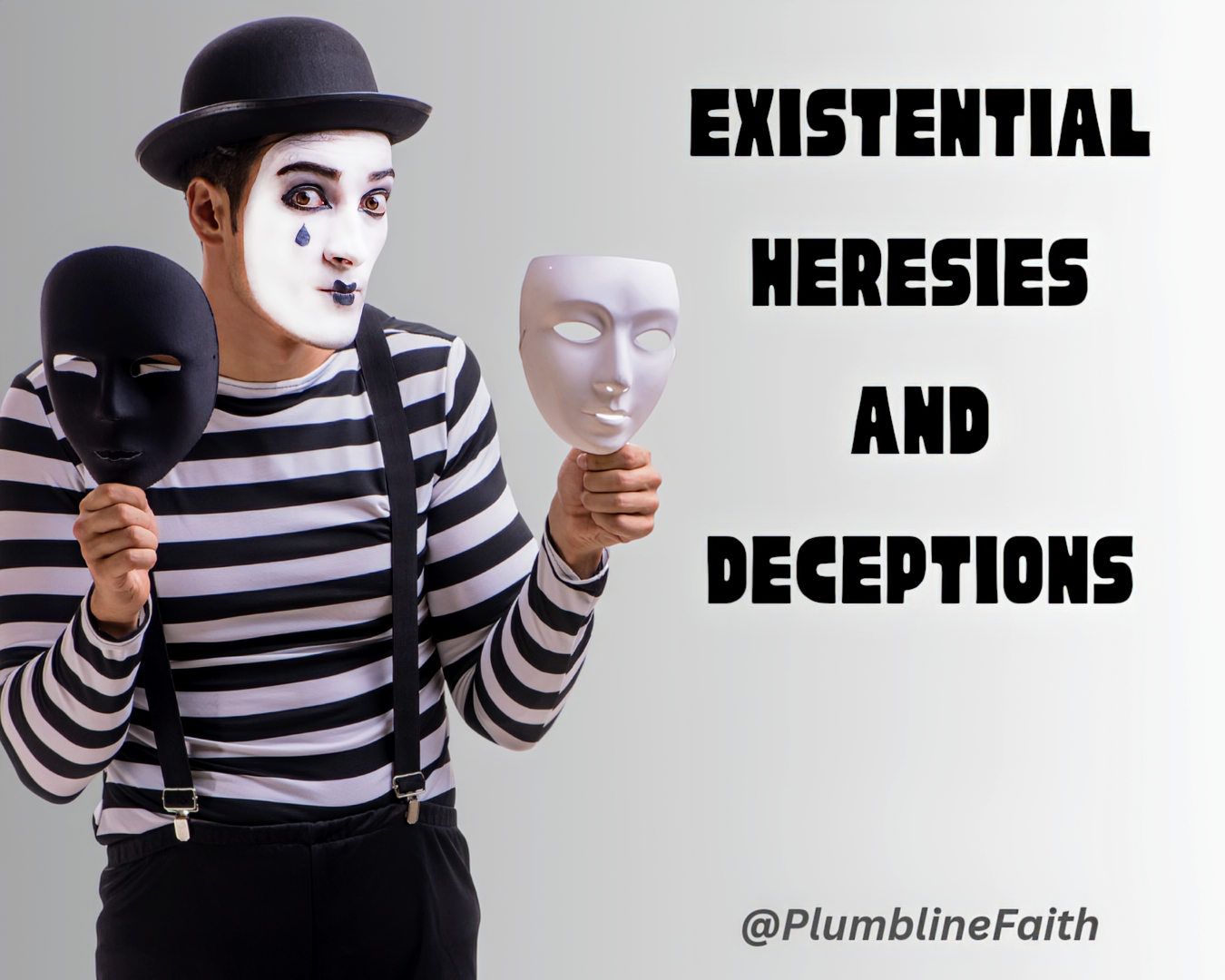
What is existentialism, and why does it matter?
Existentialism is a worldly philosophy which believes that each individual can define – on their own terms – what is true, right and real based on their own perceptions and personal sensibilities.
Many “Christians” do this, whether consciously or not.
They often claim to have a “high view” of Scripture, but then discount anything in it which contradicts their own perceptions and sensibilities.
Whether they call themselves “Progressive,” “Red Letter,” “Beyond Evangelical,” “Deconstructed,” “Neo-orthodox” or whatever …
They set themselves over God’s plenary authority of Scripture by defining truth, reality and morality on their own terms to suit their own purposes.
Inevitably, this leads them to project their own perceptions and sensibilities onto Jesus Himself …
To create a “Christ” after their own likeness and image.
In essence, they end up worshipping themselves by deceiving themselves through their false Christ …
Who is nothing more than a representation of themselves.
Like any idol, this “Jesus” of their own creation then justifies their religion of self …
Both to themselves (whether knowingly or not) and to those they seek to deceive (again, whether knowingly or not).
Unfortunately, our “churches” today are filled with such people …
Because many “churches” find it’s easier to cater to their narcissism than call for true repentance.
Existential deception is a defining issue of our times because the real Jesus didn’t choose to leave everything up to our personal foibles and follies …
But chose to authoritatively define Himself – and what is ultimately true, real and right – through Scripture as His written Word.
Anything less is a lie.
We can not deserve, earn or initiate God’s grace …
Otherwise, it’s not grace.
But once offered …
We certainly can turn from it.
Otherwise, it’s likewise not grace.
The Bible doesn’t say to believe in yourself …
But to die to self.
Jesus never said to forgive yourself …
But to forgive others and then ask God to forgive you.
The Gospel isn’t about affirming you …
But about repenting and surrendering to Christ’s rule.
Only then will you find yourself …
Your freedom …
And your validation …
As defined by Him.
 Plumbline Faith