Plumbline Faith

Simple Faith, Simple Truth, Simple Virtue

SCRIPTURAL MANDATES FOR RELATIONAL PARTICIPATORY CHURCH — February 24, 2025

SCRIPTURAL MANDATES FOR RELATIONAL PARTICIPATORY CHURCH

There are numerous New Testament mandates which require that our gatherings as the church be participatory, with ministry one to another out of the diverse gifts God distributes among us.

Unfortunately, however, what we tend to have these days are “mono-churches” that are centered around the monopolizing monologue preaching by the “one” …

Or centered around one particular gift, vision or ministry emphasis.

Instead of mono-churches, here are just some of the New Testament’s many commands about how we are to gather and function together as the multi-part, multi-functional, multi-gifted Body of Christ …

For the mutual edification and building up of each other by one another.

Continue reading
“CHURCH” INSANITY — February 23, 2025

“CHURCH” INSANITY

Why?

Why are there no “Senior” or “Lead Pastors” in the New Testament?

Why are monopolizing, one-man “sermons” prohibited in the New Testament?

Why is “preaching” never in church to believers, but only to unbelievers, in the New Testament?

Why are obligatory church tithes contrary to the actual standard of giving for Christians in the New Testament?

And why is the idea of building large “church” buildings utterly missing from the New Testament?

Continue reading
JESUS, UP CLOSE AND PERSONAL — February 21, 2025

JESUS, UP CLOSE AND PERSONAL

As an elder in our simple, relational, participatory churches, I’ve done more than just teach sound doctrine.

I’ve also routinely helped folks literally encounter a vibrant, living Christ who personally transforms them.

In fact, healthy, relational, participatory churches are impossible, I have found, without ongoing internal transformations in the lives of those who gather.

I recall meeting with a man who loved the Lord but had re-occurring bouts with drug addiction.

He was serving time in the local jail and part of an indigenous, relational participatory church we helped start in one of the dorms there …

But he was carrying lots of guilt and shame from things in his past.

Yet despite all the good doctrine he previously learned and fully embraced, he couldn’t shake the weight of those sins.

This was a common problem among those we’d reach in the jail, the woods, and other places at the fringes of polite society.

As I often did when meeting with such men, I simply invited him to verbally confess and expose to the Lord the sins and the burdens that were weighing him down – openly and fully.

In tears, he did.

I then simply invited him to ask the Lord to forgive him for all the stuff he’d just revealed  – in his own words and in his own way.

With a contrite heart, he did.

Finally, I simply asked him to bundle up all the guilt, all the shame, and all the confusion his heart had been carrying …

And lift it up in his spirit as he gave it to the Lord – then tell me when the Lord took it.

In simple faith, he did …

And he was free.

The look of release, wonder and amazement in his eyes left no doubt.

I then just sat back and simply stayed quiet as the Lord came and ministered to him.

After several minutes of watching the Lord’s peace and calm engulf him, I asked what had happened. (I always love asking folks to tell me what happens when the Lord literally meets them.)

He said the Lord had been hugging him.

I smiled, because I knew that Jesus had just brought profound healing to him, and had lifted the emotional pain from his life that kept driving him back to drugs.

He now was on the road to effective discipleship and recovery.

The beauty of helping him actually meet Jesus is that I didn’t need to have all the answers, or the cure, or even figure out all the problems in this precious man’s life.

I just needed to get to simple, which for this brother meant inviting him to confess, seek forgiveness, and trustingly turn his burdens over to the Lord …

Not metaphorically, but literally.

And like He always does, Jesus showed up.

This was not an unusual event, and in my experience Jesus personally and directly meets each person differently and uniquely based on their varying, individual needs.

That’s the Jesus I know.

He heals the brokenhearted, delivers those captured by sin, and brings liberty to the oppressed.

Yes, we need to affirm sound doctrine, but we also need to help people meet the living Christ …

Up close and personal.

OLD “CHURCH” AND NEW WINE — February 19, 2025

OLD “CHURCH” AND NEW WINE

Whether by design or default, over the last few decades some discovered they could build big followings and big buildings with rows upon rows of spectator seating and a big stage for Sunday performances that showcase their own ministries, and call it “church” …

If they could also figure out how to manipulate people’s feelings and call it “worship.”

Where did they even find that in the New Testament?

They didn’t.

That’s why God is now calling many back to simple faith through true worship …

Which is living lives of humble reverence and sacrificial obedience to Him.

And also back to simple assemblies …

Where we mutually build up one another through ministry to each other.

You know, just like the New Testament commands.

But one of the biggest hindrances to getting there, I’ve found, is the tendency to still adopt aspects of the “show” and its faux “worship,” howbeit in smaller settings like homes ….

As though new wine can go in old wine skins.

It can’t, so don’t even try …

Because home assemblies, as shown in the New Testament, don’t work if they’re simply “honey, I shrunk the ‘church.'”

THE HISTORY OF TITHING — February 9, 2025

THE HISTORY OF TITHING

The idea that Christians should tithe to churches isn’t found anywhere in Scripture.

Rather, the New Testament command for believers is much different:

“Each one must give as he has decided in his heart, not reluctantly or under compulsion, for God loves a cheerful giver.” 2 Cor. 9:7

In fact, the idea that we must tithe to churches didn’t arise until the 6th Century – many hundreds of years after the New Testament was written.

Does that surprise you?

It emerged only after the “church” became something far different than a functional, multi-gifted, local community of believers who gathered in homes and other places where life naturally happened, to mutually encourage and minister one to another like the New Testament commands.

Instead, the church morphed over hundreds of years into more of a temple model and away from its simple New Testament roots.

As it became increasingly self-focused, self-interested, and “institutional,” the tithe became necessary to pay for:

– A growing clergy/laity divide with increasingly hierarchical leadership which displaced the New Testament model of multiple, unassuming elders who emerge within local assemblies to serve among God’s people;

– “Worship” and ritualistic “sacraments” that evolved into staged, scripted “services” that required a new professional class of Christians to “mediate” and “officiate;” and

– The migration towards dedicated buildings that became centralized seats of authority for the new, professional leadership class – and ever larger, expensive, and more elaborate monuments to their own positions of power and control.

So of course, as authentic New Testament churches receded in lieu of post-Biblical institutional “churches,” the “tithe” arose …

Because it costs a lot of mula to feed that beast.

CHURCH: SIMPLE, PARTICIPATORY, ORGANIC — February 8, 2025

CHURCH: SIMPLE, PARTICIPATORY, ORGANIC

Warning: Satire below! 👇

That guy over at Plumbline Faith keeps saying that church, as shown in the New Testament, is simple, participatory, and organic …

With ministry one to another for our mutual edification.

So what’s his problem???

Participatory?

I do that.

I sit and stand when the worship leader tells me to and sometimes even sing along, do the happy clap or raise my arms with my eyes closed when prompted;

I shake hands with the guy in the pew ahead of me when the associate pastor says to greet one another;

On occasion I say “amen” when the senior pastor asks us to say “amen” during his sermon;

I put money in the plate when it’s passed down my row by the ushers; and

I even bow my head when told to do so during the invitation for folks to raise their hands and receive Jesus.

So yes, I participate when I go to church, thank you very much!

Simple?

I do that also.

I find a spot in the church parking lot exactly five minutes before the service starts;

Passing through the foyer, I give a perfunctory reply to the perfunctory greeter’s perfunctory greeting;

I continue through the big lobby to the comfy pew where I always sit;

During the show I stand, clap, sing, raise my hands and bow my head, exactly as prompted from the stage;

I feel the “spirit” move me – right on cue – when the worship band hypes it up a notch;

I am inspired and nod my head – also right on cue – at all the right spots in the pastor’s sermon; and then

I get up to leave at 11:00 am – right on the dot – when it’s all over.

Seriously, what could be simpler???

Organic?

Yup, I do that too.

The new coffee bar in the church lobby uses only certified organic, GMO-free, fresh-roasted, hand-ground beans for their lattes.

And you can’t get more “organic” than that.

Yes, indeed, I love my simple, participatory, organic church!

P.S.

I did hear, however, that a new church down the street uses a fog machine with their band to create just the right amount of awe during the show – oops, I mean worship. I think I need to check that out, because I just might love church even more if they have a cool fog machine!

~ Jim Wright
   (feeling just a little mischievous)

TITHING: MYTHS AND FACTS — February 7, 2025

TITHING: MYTHS AND FACTS

Have you been deceived with modern day myths about tithing?

Here are the facts:

Tithing didn’t come into the Church until many centuries after the New Testament was written.

Why? Because by the 6th century, an increasingly self-serving ecclesiastical hierarchy began needing to fund a host of unbiblical prerogatives they had started assuming for themselves.

For those, however, who nonetheless insist on shoehorning this Old Testament practice – which was part of God’s provision for funding the nation of Israel under the Old Covenant – into New Testament life, I only ask that you be consistent.

In the Old Testament, the tithe was limited to 10% of a farmer’s or herder’s produce from the land, such as fruits, crops and livestock. See Leviticus 27:30-33.

It was never, ever instituted anywhere in the Old Testament on monetary income, or non-agricultural products and tradesmen …

Such as carpenters, metal workers, stone masons, and the like.

Furthermore, only 1/3 of 1% of the agricultural produce – rather than 10% – was tithed to the temple and the temple priests. Yet today, pastors and churches want to claim a full 10% tithe!

In fact, under the Old Testament, the tithe was given over a three year cycle.

In one of the three years, the tithe went to a local Levite, who was forbidden under the Mosaic law from owning land. Instead, they served – as we see throughout the Old Testament – as a local community adviser, judge, peacemaker, teacher, charity administrator and civic leader. See Numbers 18:23-24 & Deut. 33:10, among many other verses.

And even then, there was no absolute right to the tithe by any particular Levite. Rather, the tithing farmer or herdsman gave 10% of his produce in year one only to those Levites who were actually doing their jobs well.

Thus, there was no entitlement.

Nope, not, nada, just ain’t there.

Interestingly, in the various census counts in the Old Testament, the Levites were always about one-thirtieth of the total population in Israel. So getting, in effect, one-thirtieth of the produce of the land (10% every third year) came out just about right.

Sorry if the math is confusing, but in essence, this meant that the tithe given to the Levites equaled the average income of the people they served – no more and no less.

No one got wealthy or lived above the average income level from the tithe!

Nope, not, nada, just ain’t there.

The Levite, in turn, was required to give 10% of his 10% to the temple storehouse to fund temple operations and to support the temple priests. See Numbers 18:35-28.

Again, sorry if the math is confusing. But this meant that the temple and the temple priests got only 1% of the farmer’s produce every third year.

Or, to put it another way, only 1/3 of 1% of the total tithe went to the priest and the temple.

I bet you never heard about that in any sermon telling you to tithe!

So what about the other two years out of the three year tithing cycle?

In the second year, the farmer was to tithe 10% of his produce to support the poor, the landless, widows, orphans and destitute aliens. See Deut. 14:28-29 & 26:12-13.

In the third year of the tithing cycle, the farmer was required to spend his 10% tithe on partying.

Yes, you read that right!

He was to use the tithe to take his family on a vacation, where they would go to Jerusalem for a week of eating, drinking. and partying. See Deut. 14:22-26.

So next time some preacher tries to guilt you into tithing, tell him “yes, sir!” …

Then take a vacation! 😎

In summary, should we now give cheerfully as God directs based on actual ability?

Yes! That’s the new standard for giving in the New Testament, which says:

“Each one must give as he has decided in his heart, not reluctantly or under compulsion, for God loves a cheerful giver.” 2 Cor. 9:7

But require God’s people to pay 10% of their non-agricultural income to a church or pastor???

Nope, not, nada, just ain’t there!

WHY DO WE GATHER? — February 5, 2025

WHY DO WE GATHER?

I’m not trying to shock or upset anyone.

Instead, I want to help you start considering church as the New Testament actually commands it, rather than church as you’ve come to presume it.

So here’s an interesting fact:

The New Testament has numerous imperatives about why, and how, we should gather as the church …

But never once does it say it’s to “worship” God or have a “service.”

In fact, our modern notion of going to church for a “worship service” is utterly absent from the New Testament.

Nope, not, nada …

Just ain’t there.

Why?

Because the New Testament – in multiple passages – explicitly commands us to gather together for a different reason …

Which is to mutually edify, build up, and encourage one another as we minister to each other so we can grow together in our faith and become mature, functional believers.

For example, the only reason the New Testament says we should sing God’s praises …

Is to encourage each other.

But instead of the New Testament’s horizontal imperatives about being the church, one for another …

We have substituted post-Biblical notions that “church” primarily has a vertical focus …

As though we should go to some building to find or invoke God’s presence rather than encourage one another with the Living God who now dwells in us.

So instead of simple, participatory gatherings with unpretentious ministry one to another …

We now have special buildings dedicated to “worship,” with special “worship services” performed by a special class of priestly intermediaries called “worship leaders” who usher us into God’s “presence” while insuring we give big weekly “collections” of “tithes,” immediately followed by another hired professional intermediary called a “senior pastor” who monopolizes our gatherings through monologue “sermons” from an elevated stage with an “altar” and spectator seating.

NONE of that exists in the church as commanded in the New Testament …

And, in fact, it prevents us from actually being the church like the New Testament says.

Instead, true “worship” under the New Covenant is each of us individually living lives of reverence and sacrificial obedience to God – holy and acceptable before Him …

24/7.

When we then gather together, we are commanded to mutually edify, build up, and encourage one another in that like, common faith.

Nothing more …

Nothing less.

If that rattles your presumptions, then do as the Bereans …

Who diligently searched Scripture to see what it really says.

When you finally confirm these truths in His Word for yourself …

I simply suggest that you ask God what He then wants you to do about it.

Because real faith is about trust and obedience …

Not our human traditions and comfort zones.

MINISTRY ONE TO ANOTHER — February 3, 2025

MINISTRY ONE TO ANOTHER

Here’s just some of the New Testament imperatives about our gatherings as the church being participatory, with ministry one to another out of the diverse gifts God distributes among us …

Rather than ministry by the “one.”

These are not merely descriptive, but Biblical mandates.

“What then, brothers? When you come together, each one has a hymn, a lesson, a revelation, a tongue, or an interpretation. Let all things be done for building up.” 1 Cor 14:26

“And let us consider how to stir up one another to love and good works, not neglecting to meet together, as is the habit of some, but encouraging one another, and all the more as you see the Day drawing near.” Heb 10:24-25

Leaders in the church do not have a monopoly on ministry, but instead are “to equip the saints for the work of ministry, for building up the body of Christ …” Eph 4:12

We are not to be the church based on “human cunning… Rather, speaking the truth in love, we are to grow up in every way into him who is the head, into Christ, from whom the whole body, joined and held together by every joint with which it is equipped, when each part is working properly, makes the body grow so that it builds itself up in love.” Eph 4:14-16

OUR JOURNEY — January 29, 2025

OUR JOURNEY

Twenty years ago I was leading many to the Lord, especially from the local jail and other places at the edges of polite society.

I would then try to get these new believers plugged into the church I was attending – which at the time was considered a solid, dynamic, Bible-believing church.

But try as I did, it never seemed to happen. New converts from the “street” are good at seeing through facades. They’d quickly sense all the hypocrisy and phony represented on the front stage each Sunday – and wanted no part of it.

It got to the point that I couldn’t, in good faith, bring them anymore to that church. But I couldn’t find another church that didn’t have the same issues, rooted in the very hierarchical, pastor-centric structure common in nearly all churches here in the U.S. over the last several decades.

Essentially, those churches are more about the power, position, and prestige of the “senior” leader than about true ministry to one another for the mutual edification of each other …

Even though the New Testament condemns the former but commands the latter.

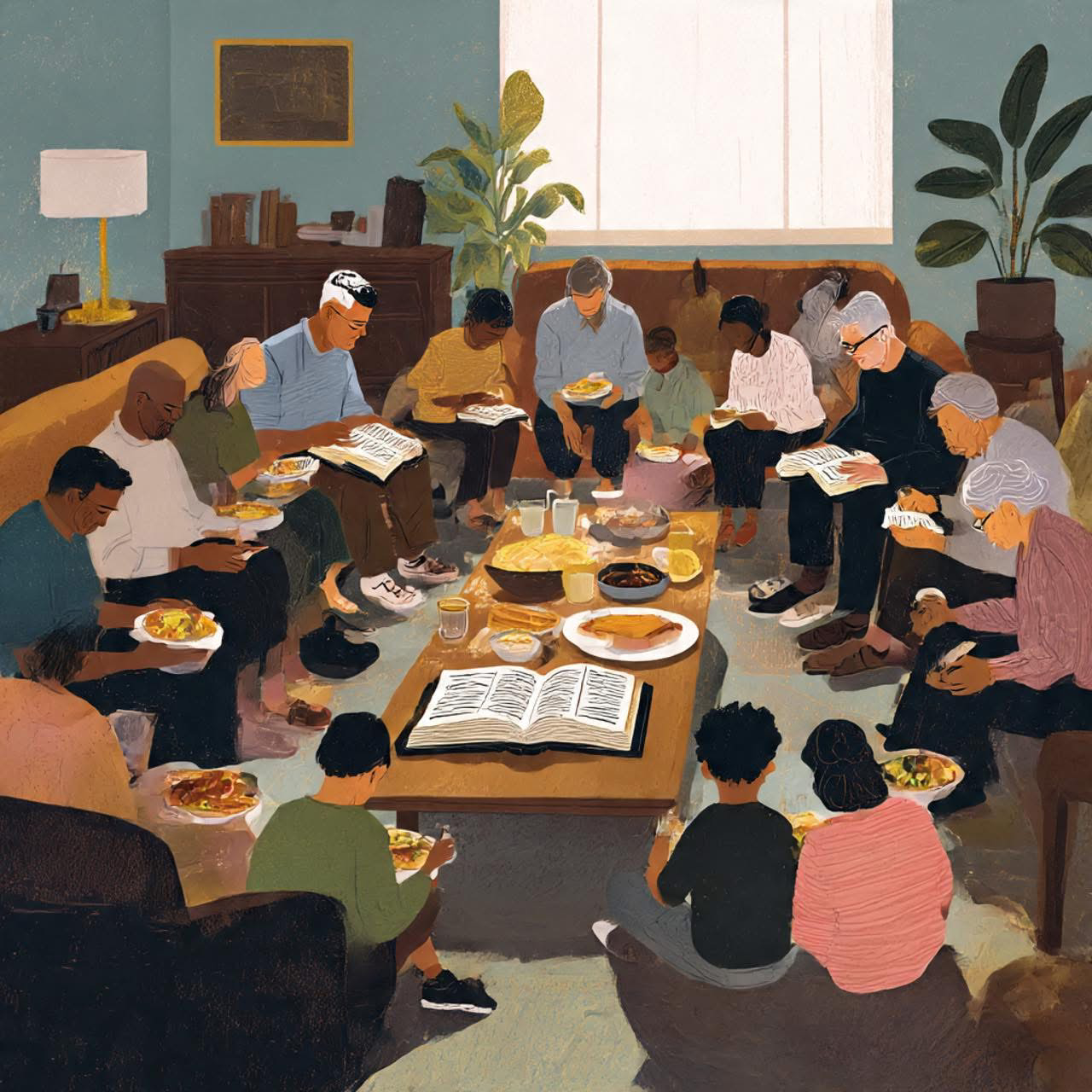
So I quietly started opening my home on Friday nights for a meal and fellowship, where everyone could share, be real with each other, and encourage one another in the Lord.

That was the beginning of our journey over the last twenty years into relational participatory gatherings with flat, rather than hierarchical leadership, which focus on ministry one to another instead of ministry by the one.

It’s been challenging at times, but I’ll never go back to the old model.

Perhaps it’s time that you too take a chance, step out in faith, and trust that being the church as the New Testament actually shows it is indeed possible …

Despite all of your prior presumptions about church as you’d previously come to know it.

See what the New Testament actually says, seek the Lord about what He wants and let Him prepare you, then do wherever He says …

Even if it leads you outside your comfort zones.

WORSHIP? — January 28, 2025

WORSHIP?

Contemporary, traditional, spontaneous, liturgical, a cappella or instrumental …

The problem with the ongoing “worship” wars is that all sides miss some central truths.

Although the New Testament has a lot to say about Christians assembling together …

No where does it include “worship” as an element of our gatherings.

Nope, not, nada …

Just ain’t there.

Yes, we are told to sing praises to God …

But for the sole purpose of encouraging one another, rather than as an act of “worship.”

You might be further surprised to learn that the New Testament Greek words translated as “worship” don’t mean singing.

Instead, they specifically refer to the temple rituals of prostration and animal sacrifice, both Old Testament and pagan …

But not New Testament gatherings of believers.

In fact, the current idea of Christians going to “God’s House” to “worship” at a “service” is utterly missing from the New Testament.

Rather, we are repeatedly commanded to simply gather for mutual edification and to build each other up …

Through horizontal ministry one to another as the multi-part, multi-gifted Body of Christ.

That’s a far cry from “church” as we’ve come to know it …

Regardless of how you otherwise might want to define “worship.”

MIS-TRANSLATIONS — January 8, 2025

MIS-TRANSLATIONS

Did you know that the King James Version (KJV) was a deliberate mis-translation written to undercut reform movements that might challenge established religious traditions?

King James actively used the official English church to advance his own power. To further that goal, he wanted a Bible translation that propped-up the existing church establishment that was under his control.

To do so, he ordered the translators to follow 15 rules. Rule #3 required that “The Old Ecclesiastical Words to be kept, viz. the Word Church not to be translated Congregation etc.”

This means the King James Version is purposely biased against the actual meaning of the original Greek text, especially where it might undercut prevailing, traditional notions of “church.”

Unfortunately, subsequent English translations often lacked the courage to remedy those biases, because doing so would upset people and hurt sales.

For example, the Revised Standard Version (RSV), the New American Standard Bible (NASB), the New King James Version (NKJV), and the English Standard Version (ESV) are all based on the King James Version …

A fact that they all explicitly acknowledge but is not widely known.

I’m not saying those translations should be avoided. I use some of them all the time. But I try to avoid taking them – and any other translation – at face value.

Fortunately, there are excellent resources – like comprehensive scholarly lexicons – which help free us from translation bias.

New Testament lexicons are much more than a concordance or dictionary. They provide an in depth analysis of a word’s context and meaning, in its original language, as commonly used in the vernacular of the day during the first century.

Good lexicons thus can help us understand the original intent of the New Testament, without translation bias, as actually written in the first century under the inspiration of the Holy Spirit.

Doing so, however, requires an unsettling willingness to step outside of prevailing comfort zones and surrender to Scripture …

Based on what it actually meant when written.

HURTS OR HEALTH? — December 22, 2024

HURTS OR HEALTH?

We’ve encountered, in our relational participatory churches over the years, a common problem that enslaves many Christians and hinders their ability to initiate or enter into healthy fellowship.

It occurs when longstanding hurts, disappointments and emotional wounds become so ingrained into someone’s sense of identity …

That it begins to define them.

When this happens, it’s hard for them to transparently expose and turn those core issues over to Jesus.

So rather than finding liberation and wholeness through new life in Christ, along with healthy fellowship …

They become stuck in their past and can’t move forward.

Here’s the thing:

The New Testament says that elders are supposed to function pastorally, but most church leaders these days have no idea how to help people find emotional wholeness and healing in Christ …

And don’t even try.

Yet if you want to help people find healing and healthy community, you need to be willing to start gently walking one-on-one with them to their internal places of hurt.

Once there, allow them to finally express – fully, openly and verbally – their past and their pain to Jesus …

And, if needed, guide them towards openly and verbally forgiving those who wronged them and then have them ask God to forgive them for how they let the offense – rather than Him – define them.

This is the nitty gritty of confession and forgiveness in action.

Next have them bundle up the hurt in their spirit, lift that bundle up and explicitly release it to Jesus.

This is the nitty gritty of repentance in action.

When they do, we’ve seen that Jesus always takes it, and in turn always gives them healing and wholeness in exchange.

No exceptions!

This is the nitty gritty of redemption in action

Because where there was bondage before, now there is the beginning of new life and healthy community in Him.

THE ROLE OF ELDERS — December 18, 2024

THE ROLE OF ELDERS

Don’t assume that relational participatory churches don’t need leaders.

In fact, it takes strong, secure leadership to create and maintain a safe environment …

Where others feel secure enough to come forth and minister one to another for the mutual building up of each other like the New Testament commands.

To help achieve that, the New Testament provides for elders (plural) who, among other tasks, watch over and protect each local church.

We do that by helping to equip everyone else to do works of ministry according to their diverse gifts, rather than assuming the primary burden of ministry ourselves …

And by creating a safe, secure environment in our gatherings where everyone feels free to actually come forth in ministry, one to another.

As an elder in a relational participatory church that meets in my home, I can attest to the weighty responsibility this puts on us.

To do it well takes humility as we discern when intervention is actually needed to protect the church and its members …

And then firm action when it is.

For example:

In my experience, smaller relational participatory churches like we see in the New Testament …

Often attract people who tend to dominate the gatherings – either intentionally or unintentionally – with their own unresolved issues, pet doctrines and individual agendas.

They haven’t learned to properly prefer and minister to others, and participate out of their own issues instead.

A good elder sees what’s happening and privately tries to work with them to help them come into balance.

But if they refuse, and persist in trying to dominate the church and thwarting it’s ability to function as the multi-gifted, multi-part Body of Christ …

The elders must act.

Otherwise, without proper leadership …

Those churches will inevitably fail, no matter how good everyone else’s intentions may be.

Ultimately, the goal of Biblical leaders must be to help folks properly come forth, rather than elevating themselves over the church.

So the issue isn’t whether we need leaders, but how they lead …

And whether they truly function as servants to all.

ELDERS: PASTORS AND TEACHERS — December 17, 2024

ELDERS: PASTORS AND TEACHERS

Why do we persist in making our churches dependent upon, and primarily revolve around, a “Senior Pastor” …

When no such position or role exists in the New Testament?

Eph. 4:11 is the only verse where the Greek noun translated as “pastor” is used in the New Testament regarding the church.

That’s it. Just once and nowhere else.

Yet we’ve taken that one passage out of context and built our current, prevailing “pastor centric” model of church and church leadership around it.

Continue reading
GOD AND GOVERNMENT — December 16, 2024

GOD AND GOVERNMENT

Years ago, I was twice elected to local political office.

I was happy to serve, but it reinforced a basic truth that we ignore at great peril.

Healthy civilizations and societies are a Christian virtue …

Promoted to preserve liberty by those who heed Christ’s Lordship in all spheres of life and human endeavor.

Trying to use civil government to compel personal faith and piety, however, is a “Christian” vice …

Promoted by those who ignore God’s specific jurisdictional limitations for different spheres of life and human endeavor.

For example, God in the New Testament empowers civil government to protect good people from bad people …

Rather than empowering it to naively try to convert bad people into good people.

Biblical Christians understand these limits, and work to insure that government faithfully does the former …

While “Christian” nationalists and so-called progressives want to tyrannically give God-like powers to government in an attempt to do the latter.

Understand this difference, and you’ll understand the origins behind the intense political conflicts currently gripping our nation.

Let’s rededicate ourselves to civic engagement and preserving liberty …

But on God’s terms, as He defines and limits government.

OUR LIBERATING DIFFERENCES — December 7, 2024

OUR LIBERATING DIFFERENCES

Many have been deeply wounded by churches and ministries that used them – often when they were young and naive – to advance a particular leader’s vision by trying to mold them to his own gifts and callings.

Eventually, their own unique gifts, callings and God-given identity became subsumed to another man’s grand agenda …

And began to atrophy.

It’s liberating, however, when we finally learn that God did not create us to be like anyone else …

But instead gives us different personalities and motivations to match the differing spiritual gifts, callings and abilities He distributes among us.

So let’s be willing to learn from one another, while also experiencing His pleasure as we uniquely use and enjoy His differing gifts as He intended …

In our lives, families, fellowships and communities.

JURISDICTIONS AND LIMITATIONS — December 2, 2024

JURISDICTIONS AND LIMITATIONS

Why are the twin sins of “Christian” Nationalism and Progressive “Christianity” so dangerous?

When we give civil government the rights and responsibilities that God has reserved for Himself, or separately delegated to individuals, families, and the church …

We become its supplicants, and it our idol.

And like with all idols, unrestrained government power will inevitably lead to tyranny and bondage.

In contrast, civil liberty exists when the different jurisdictions of the individual, the family, the church and civil government …

Each stay in their separate God-ordained lanes – rather than trying to usurp the rights and responsibilities of each other.

For example, in the New Testament, God gives civil magistrates the power to provide for our common good and protect us from evildoers.

But He never gives civil magistrates the right – or responsibility – to make us personally “good” by compelling us to adopt particular beliefs or ideologies (religious or otherwise).

Nope, not, nada …

Just ain’t there.

Instead, God gives us – as individuals, families, and communities of faith – different roles and responsibilities for how we live holy and righteous lives before Him.

This highlights the fundamental flaw of both “Christian” Nationalists and Progressives:

They want to seize expansive government authority to impose their own notions of being “good” individuals on everyone else, beyond simply protecting us from evil so we can work out our own salvation before God …

By usurping what God has ordained for Himself and delegated to other spheres of authority.

So the choice is not between tyranny on the Right by “Christian”  Nationalists …

Or tyranny on the Left by “Christian” Progressives.

Rather, it is whether we will uphold the separate and distinctly different rights, responsibilities and limits assigned by God to individuals, families, churches and civil governments …

And thus preserve the blessings of Godly liberty FOR ALL.

SIMPLE CHURCH IS HARD — November 23, 2024
SUBMISSION — November 19, 2024

SUBMISSION

In marriage …

In the church …

And in so many other circumstances …

Problems begin to clear up when we learn to prefer each other above ourselves.

And if you think you’re the leader and this is about others needing to prefer you over themselves …

It’s not.

Because with that attitude …

You’re the problem.

MARKED FOR LIFE — November 10, 2024
GOD AND SCOUNDRELS — November 5, 2024

GOD AND SCOUNDRELS

Often, voting for Godly principles means voting for personally flawed candidates.

I’m not excusing their individual faults, but consider this:

In Scripture, God often chooses scoundrels to alter history and change the course of nations.

Maybe that’s because He understands a basic truth that makes many uncomfortable.

Like, perhaps, it takes unconventional, strong-willed people with the attitudinal disposition:

To flaunt social norms and expectations in their personal lives (for good or for bad);

Never care about going along to get along; and

Never play it safe …

To confront – and upend – the corrupt, entrenched power structures of their day.

That doesn’t mean God gives them a free pass on their associated personal flaws.

As Scripture also makes clear, He doesn’t.

But neither does He typically choose those who are reputable, conventional, or safe …

When He decides to shift history and reform nations.

And fortunately for us, God’s not yet done with history ..

Or with nations.

THE PROBLEM WITH PULPITS — October 19, 2024

THE PROBLEM WITH PULPITS

Many blame the problems of America on our pulpits.

I tend to agree …

But for entirely different reasons.

The problem is not that churches lack strong pulpits with strong preaching …

But lack strong disciples who can function together as the multi-gifted, multi-part Body of Christ.

Big difference!

Continue reading
VIRTUE AND VOTING — October 14, 2024
THE MYTH OF NEUTRALITY — March 18, 2024

THE MYTH OF NEUTRALITY

“Silence in the face of evil is itself evil:
God will not hold us guiltless.
Not to speak is to speak.
Not to act is to act.”

~ Dietrich Bonhoeffer

There is no neutrality.

Not choosing is, in fact, to choose the status quo …

And often that’s the greatest evil of all.